


The Making of the ‘Mail Bag’ Scissors
There was a time, not so very long ago, when the rhythm of Britain’s postal system depended on a simple, purposeful tool.
For decades, the General Post Office (GPO) ordered tens of thousands of specialist scissors each year, at its peak, as many as 55,000 pairs annually. These were not ordinary scissors but working tools designed for a singular task: opening mail bags swiftly, safely and reliably in the country’s vast sorting offices.
Around twenty years ago, we were invited to one of Sheffield’s major sorting depots, set along one of the city’s busy arterial roads. Inside, among the constant motion of sacks, sorting frames and conveyor belts, we met the people who used these tools day in and day out. Their insight proved invaluable.
They spoke not in abstractions but in practicalities. The scissors, they explained, needed to be comfortable enough for repeated use across long shifts. They had to cut through a wide variety of fastenings – string, twine, plastic ties – without hesitation. Above all, they had to be safe: no sharp points that might catch, jab, or injure when carried in a trouser pocket.
It was a tool shaped entirely by its environment and by the hands that used it.
Designed by Use, Perfected by Craft
From these conversations, a new design began to take shape.
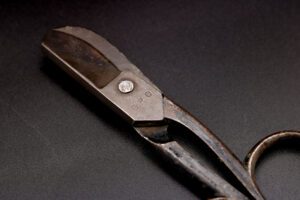
Longer handles were introduced to provide greater leverage when cutting through tough tie-wraps. The blades were given a rounded, blunt tip – removing the risk of accidental injury without compromising performance. Comfort was paramount, so the handles were shaped to sit naturally in the hand, even through hours of repetitive use. At the pivot, a strong and dependable screw ensured lasting durability under constant strain.
Equally important was how the scissors were made.
We adopted an alternative forging method, shaping the steel into scissor blanks with far less waste than traditional drop-forging. It was a quieter innovation, perhaps but one rooted in the same Sheffield principles: efficiency, material respect and enduring quality. Less waste, lower cost without sacrificing strength.
It was, in every sense, a working tool – honest, considered and built to last.
From Mail Room to Garden
As the years passed, the demands of the postal service changed. New methods of packaging and dispatch gradually reduced the need for these specialised scissors and orders from the GPO slowed to a near halt.
But a well-made tool rarely loses its purpose entirely.
It wasn’t long before their qualities were recognised elsewhere. The same strength, leverage and safety that made them ideal for cutting mail bag fastenings proved equally suited to the garden. Twine, stems, light pruning, the scissors handled them all with ease.
And so, without fanfare, the Mail Bag Scissors found a second life.
Today, they are known simply as pruners – a name that reflects their new role but not the long and industrious history behind them.
A Tool with a Story
Every pair carries a quiet legacy: of sorting offices and early mornings, of problem-solving on the shop floor, and of Sheffield craftsmanship responding to real-world need.
It is a reminder that the best tools are not designed in isolation but shaped by use, refined by experience and carried forward by those who recognise their value – whatever the task at hand.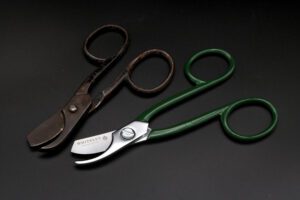
Shop our pruning scissors here
Follow us on social media to find out our latest updates:

 Facebook